Tuesday, 14 March 2017

Science is not the enemy: A Response to "Limits of science, trust and responsibility"

Brian Cox' comments regarding the limits of physics and the supernatural certainly have opened some old wounds in the paranormal community, but let's not pretend that anger and mistrust of science and scientists is anything new. It's especially prevalent in the psi-supporting pockets of said community.

I suspect this is due to some of Psi's leading figures, Rupert Sheldrake especially, making a nice career in book sales and on the lecture circuit presenting science, the modern edifice of academia and scientists in particular as the enemy of psi research. Claims of rejected papers, silenced and ignored researchers and nasty skeptics abound. I will hardly be the first to point out that much of Sheldrake's ire seems a result of his perceived rejection by the scientific community. The truth is amongst the many facets of the scientific method is the concept of replicability. If results of an experiment are to be accepted they should be replicated by independent researchers and yield similar results. Experiments in psi suffer from a huge replicability crisis. Positive results disappear when experiments are conducted by independent teams of researchers, especially when these teams tighten up on the methodology used by the original experimenters. A great example of this would be Daryl Bem's Ganzfield experiments hailed at one time as a breakthrough in psi research, many teams attempted to replicate Bem's results and met with abject failure.

I recently came across an article written by Tom Bulter (above), Co-Director of  ATransC, an organisation which collects various ITC and EVP "studies" and "evidence." Butler also served as an advisor to Michael Keaton horror film "White Noise". The piece, entitled "(An) Open Letter to Paranormalists: Limits of science, trust and responsibility"  couldn't more reflect the mistrust and anger at the scientific establishment that I discussed above. In showing just how wrong the author is, I hope to also show that science isn't the enemy of the "paranormalist" but should be wholeheartedly embraced by anyone with the slightest hope that paranormal research will ever have a shred of credibility.

The letter is directed to "paranormalists" a term Butler uses in much of his material, which he defines as:
"paranormalist(s) are people who experience, study or have a more than casual interest in psychic ability (psi functioning, remote viewing, healing intention), healing intention (biofield healing, distant healing, healing prayer) and the phenomena related to survival of consciousness (mediumship, visual and audible ITC, hauntings)."

Did butler really intend to use "or" here rather than "and" as by his definition, I as someone who has never experienced anything remotely "paranormal" still qualify as a paranormalist because I have more than a casual interest in the same.

Before the letter begins Butler gives us a preamble that contains information that provides context to the letter itself:

"The “science” practiced by parapsychologists is not necessarily good. Much of it is done to prove paranormalists are delusional. You and I know that, to prove we are delusional, they must ignore or falsely represent our evidence...scientists are supposed to be our friends. Some are, but the majority consider the average paranormalist inferior in many ways … as second-class citizens that are not as smart, as well educated or as wise as people with a Ph.D."
The point of any research isn't to ignore or falsely represent evidence, it's to collect data that may eventually be considered evidence. Bulter's letter has barely begun and the antagonistic tone is established. I also get more than a touch of bitterness in Bulter's words. Sorry, but if you don't have a PhD you are less educated than someone that does, in the field that the PhD has been earned at least. This doesn't make you "inferior" but it does mean if you're arguing with a professor of biology about the theory of evolution, you are somewhat deluded. Arrogant even.
"If you want to see these phenomena properly studied, if you want informed scientists to help you understand your experiences, if you want to see this field of study evolve into a well-understood science, then it is important that you know who to trust, who to believe and with whom it is safe to trust your phenomena.... It is for you to be aware of the differences, because many of those who have not been aware of the difference, have regretted ever volunteering to be research subjects."
This is a very worrying and devicise rhetoric. Implying that believers shouldn't trust some scientists, predominantly those who don't pander to their beliefs, is simply a way for people like Butler to push bad ideas like EVP without the intervention of nay-saying skeptics or others who endorse critical thinking. OK, let's agree with Butler but go further. Don't trust scientists blindly, any of them.  And don't trust me or Butler. So check out studies, check that the methodologies used in these studies are sound. Don't trust scientists.

Trust the scientific method.

Butler goes on to discuss the model he uses to describe the paranormal in the letter. I find his use of the word "model" most interesting. Generally speaking, when scientists propose models of reality they use existing theories and data to construct them. The aim being to describe, analyse or quantitfy some complex element of the natural world. In physics models are often over-simplistic, mockingly referred to as "spherical cows" because of a joke frequently told by physicists.* Despite their simplicity, these models have utility. I wonder if Butler's model will meet these criteria?

Early indications in the preamble suggest not:
"The model is based on currently understood mainstream and parapsychological science. Unlike more widely accepted models, it is greatly informed by lessons learned from mediumship and Instrumental TransCommunication (ITC), especially Electronic Voice Phenomena (EVP)."
Hmm... so Burton's model isn't based on a pre-existing framework of laws and theories, but based on the anecdotal evidence of mediumship and highly subjective and frankly suspicious evidence provided by ITC and EVP.

The first part of Butler's letter divides parapsychologists into three distinct categories. I'm not going to detail this part too much but you can follow the above link and check it out for yourselves. The outcome of the division is clearly stated: Parapsychologists who have a materialistic world view are "debunkers" and presumably the scientists Butler suggests paranormalists should not trust. What Butler fails to grasp, or aims to ensure his audience fail to grasp, is that the scientific method is employed to ensure that experimenters world views don't taint the outcome of experiments. This does fail, but only when the experiment has a methodology that isn't robust enough- that's why transparency in science is so vital. It's also why science has peer review and replicability.

Hey, don't most psi-related studies with positive results fail replicability tests? Funny that.

Butler then gives an account of how "paranormalists" experience paranormal phenomena, involving cartesian duality. I'll be frank what follows is word salad to me. Possibly I'm just a bit thick. Also, Butler's description of our minds becoming entangled with our bodies at birth sounds suspciously like L. Ron Hubbard's crazy "thetans" story upon which Scientology is based.

Here's the full pitch:
"The avatar model seems to best describe what we know about our etheric-physical nature. The idea is that a person is the conscious self of an immortal etheric personality which becomes entangled with a human body at the moment of the human’s birth. The conscious self experiences a lifetime from the perspective of the human....

In a very real sense, you create your world. It only exists as your mostly unconscious perceptual processes assign meaning to sensed environmental psi signals. Those psi signals come from your loved ones, your collective of fellow personalities, thoughtforms, your body’s self-image and your physical body’s five physical senses.

A model that is useful and may as well be correct is that a person is necessary for a psi influence to manifest in the physical. Put differently, you, or an interested observer, provide the channel for trans-etheric influences such as EVP, remote viewing, precipitation and haunting phenomena."
 What we "know" or what Butler believes? It's a vast understatement to say there isn't any evidence of what Butler suggests, it's wild speculation. Don't worry if didn't understand a word of what Butler says here a diagram will clear things up surely?
"Here, I will explain that all the functional areas in the Life Field with Avatar Diagram (below), except the human body itself, are etheric. If you take a little time to contemplate the implications of this point, I think you will see that conscious self has experiences, and by convention, assigns physicality to experiences encountered from the avatar perspective."

I actually think Butler is unnecessarily adding complexity to the idea of Cartesian duality, this too conflicts with one of the core principles of creating a scientific model: elegance. A 2010 paper published in Nature Nanotechnology describes elegance in scientific models as follows:
“When a theory or a model explains a phenomenon clearly, directly and economically, we say it is elegant: one idea, easy to understand, can account for a large amount of data and answer many questions.” (Chris Tourney, Elegance and Empiricism 2010, Nature Nanotechnology)
Butler's model and its description do seem to meet many of the criteria of pseudoscience. Take a look at this description of how to spot pseudoscience taken from website relatively thinking and see how many points I've highlighted in Bulter's model already:


I make it the first five, plus I know this model hasn't been peer reviewed, so that's six. And Cartesian duality is frequently refuted.... full house?

The letter continues.
"Our experience in the ATransC has shown that a person tends to record EVP that confirms mostly unconsciously held beliefs."
Or could it be that a person's unconscious beliefs inform what they think they hear in those EVP responses? Much like paranormal teams that present their EVPs with screen caps, the element of suggestibility is a major factor in visual and audio pareidolia which is often overlooked. Sometimes purposefully. Apparently, key to Butler's model of the paranormal is the placement of the cart before the horse.
"This science is still evolving and these points are still only indicators, but the message to us is that what we experience tends to agree with what we believe. We tend to more often have possibly genuine paranormal experience if we believe in the paranormal. Conversely, if we do not believe in the paranormal, we might not even notice such experiences."
Again, you tend to believe you've had genuine paranormal experiences if you happen to believe in the paranormal. This isn't any form of revelation, believers are less likely to search for a rational explanation for an experience if they preemptively believe that paranormal phenomena exists and therefore IS a rational explanation.
"Research has shown that people who believe in paranormal phenomena are more apt to think a picture is paranormal then those who do not believe. This is true of all forms of phenomena. It does not mean there is no paranormal phenomena, only that some of us are not as discerning as we need to be. 
This tendency to error on the side of paranormal is used by Anomalistic Psychologists to prove that all reported phenomena are errors in perception. It can be difficult to know, when reading Anomalistic Psychology research reports, that the intention is to debunk rather than to understand." 
I'm not trained in psychology, so I can't even begin to speak about the field, but I'm as certain as a layman can be that the aim of anomalistic psychology is not to debunk anything. The aim surely, in the study of the paranormal by anomalistic psychologists and parapsychologists is to understand through study psychological causes for reports and experiences of paranormal phenomena. The fact that this endeavour inadvertently does debunk some reported paranormal phenomena can hardly be held against science. To suggest otherwise smacks of sour grapes.

Speaking of which.
"It is understood that scientists hold a Ph.D. in the field to which they apply the scientific method. Yes, anyone can conduct science, but the system is designed to filter out all but academically trained people. I hold a BSEE and it is acceptable for me to say that I study a subject, but saying that I am researching a subject is not technically acceptable. "

There's a reason that PhDs and those working towards PhDs tend to be considered qualified to perform research because scientific subjects are incredibly dense and complex, so much so that it's necessary to diversify and specialise in a very specific area. A deep understanding of a specialised field of study takes years to achieve. It's this level of knowledge and dedication that is required to perform research in science where new knowledge should conform with existing laws and theories.
"Remember I said that Anomalistic Psychologists deliberately ignore evidence of paranormal phenomena. To make their point, they must find ways to conduct research with practitioners that will show the practitioner is delusional or cheating. From experience, there is a good possibility that, even if you produce phenomena under controlled conditions, the resulting report will be written to suggest that you did not or in some way may have been cheating. For instance, there might be ten words acknowledging the phenomena and a hundred words explaining it away."
It's often claimed by proponants of psi research that methodologies are designed to eliminate positive results, but if the rigorous application of the scientific method eliminates positive results then they were probably an artefact of the poor protocol. This seems to be unfair to Butler, clearly from his letter he takes the application of science personally. He blames scientists for the failure of well-conducted studies to show positive results. They're out to discredit him and other "paranormalists". Or maybe science doesn't hold much stock in EVP and ITC, Butler's personal area of study, because there's nothing scientific about them?

Butler's model of mind/body duality makes one prediction:
"If I did the work correctly, the model should be reasonably close to what you believe..."
Butler has designed a scientific model with the sole purpose of conforming to his own beliefs. Science and scientists will never and should never accept this blatant sophistry.


*There is this dairy with cows and everything. The dairy farmer wants to increase his production of milk. To do this, she hires three consultants – an engineer, a psychologist, and a physicist. After a week, the engineer comes back with a report. He said: “If you want to increase milk production, you need to get bigger milk pumps and bigger tubes to suck the milk through.”

Next came the psychologist. He said: “You nee to make the cows produce more milk. One way to do this is to make them calm and happy. Happy cows produce happy milk. Paint the milking stalls green. This will make the cows think of grass and happy fields. They will be happy.”

Finally, the physicist came to present her ideas. She said: “Assume the cow is a sphere….”

Tuesday, 7 March 2017

The Mirror Missing The Mirror.. And The Investigative Team That Didn't Investigate!

I say this a lot, but prepare yourself for a new low in paranormal tabloid reporting AND the methods of paranormal "investigation" teams... 

The story "Mysterious 'spectre with face, hand and CLAWS' floats at unsuspecting woman's shoulder in chilling photo taken at homeappeared in March 3rd Mirror and marks their very real effort to snatch the title "fake news" outlet of choice, as well as the title "most ungainly headline imaginable 2017." The "news"paper tells us of a "terrifying apparition" which appeared in a photograph next to mother Lou Johnston, 44, from Hull.


The Mirror quotes Lou as follows:
"Some see the picture and automatically think it's a mirror behind me and that is a reflection - but there is no mirror behind me. I don't even own a mirror of that size... I've had so many people get in touch and say that it is something paranormal and it can't be explained at all. Lots of people see the shape of a figure stood next to me with a hand and claws. I have always been a sceptic so I just let people offer their thoughts on it.""
That's what this strikes me as glare created by the flash of a camera or other light source reflecting off something highly reflective. A mirror being chief suspect. But Lou tells us she doesn't own a mirror that size. Hmmm... so if that's the case why has the Mirror felt it necessary to crop the image in such an extreme way. They don't normally exclude heads and feet.

The answer is abundantly clear, they've cropped the image to hide what appears to be a mirror behind Lou. Need convincing you skeptical bunch?

Well, the Star ran the same story, and being generally a bit thicker and/or lazier than the Mirror they ran the picture uncropped... right above Lou's denial of owning a full-length mirror.


Take a closer (right), you'll clearly see it appears to be light reflecting from the Mirror Lou doesn't own. I actually think it's a shaft of sunlight rather than the flash, as you can see the sunlight on the carpet by Lou's feet. I know Lou claimed the image was taken at 10pm but let's face it, she's already lied to cover what she know is the blatant cause of this apparition.

The Star and the Mirror both handily (pun intended) help debunk another element of Lou's tall tale. The "claw" of the manifestation is blatantly Lou's hand. But again if you're a fan of hard evidence Lou helpful replicates her original hand on hip pose. The Star even provide a side by side comparison (below)!

So, what's the upshot of this? What does it mean for bloggers such as myself who cover this kind of tripe. Clearly, these papers don't give a fudge about what they're printing. Why the hell should we?

(continued after image)

For me, stories like this and the Star Chilean poltergeist story have done nothing but made me more resolute to continue my debunkings. This kind of blatant fabrication by the press must be called out. Make no mistake critical thinking is under attack right now. I may not be on the front line, but I'm at home selling war-bonds at least.

As long as there are people out there who take these stories seriously there has to be someone prepared to show them how false they are. As skeptics or even skeptical believers, we can't resolve to leave people behind because they're more susceptible to this rubbish than us.

Whilst I have sympathy for believers who are taken in by this rubbish, my softer side quickly evaporates when I see "investigative teams" failing to do a modicum of research. Case in point: It was shared on Facebook by paranormal group Marston Vale Paranormal investigations. 


Now frankly MVPI should be ashamed of falling for this crap, and doubly ashamed that they copy and pasted the Mirror's story to their own site. In fact, they've done this copy and paste with several recent ghost stories in the press. MVPI proudly brag about being investigators since 2009, but couldn't do the five minutes research that it took me from my couch to expose this story?

Let's compare the work they did on the recent "fishing trip selfie ghost" to the work the awesome Kenny Biddle did. Once again MVPI simply copy and pasted the story from a tabloid source, this time the Mail. Now go to Kenny's page and see what he did, he stripped the photo performed various analysis and other stuff I'm way too thick to understand (left) and got a plausible answer. There should be no reason MVPI aren't working as hard as Kenny, or me, or any number of investigators and bloggers.

As if only to compound my frustration at the team, this is the "mission statement" on their website:
"We strive to find reasonable explanations behind paranormal experiences and this is done by going to locations and using our equipment. We gather evidence of any phenomena and examine it hopefully finding a plausible reason behind our findings."

Well, you didn't do much "striving" here did you guys? And you want people, potentially scared and vulnerable people at that, to invite you lot into their homes and conduct investigations?

Further investigation on their site reveals the team's alleged dedication to rational explanations, the scientific method and identifying dismissing natural phenomena.
"We at Marston Vale Paranormal investigate to the best of our ability and the capabilities of our equipment, and using professional computer software suites we attempt to find a reasonable explanation behind anything captured either via photograph, video, audio or electro-magnetic. We take during daylight hours control images for comparisons so we have something to work with in trying to find plausible reasons for capturing light or audio at locations... Some images show capture of rain (although you are asking for trouble taking flash photos in the rain, everything turns into orbs!), insects, dust, or other organic matter, not everything on film is a 'ghost', however we prefer to use the term 'paranormal'. Paranormal is a general term that designates experiences that lie outside "the range of normal experience or scientific explanation" or that indicates phenomena that are understood to be outside of science's current ability to explain or measure. "
I guess that doesn't extend to the content of your website.

Shameful...


Monday, 6 March 2017

Meet The New Skeptical Heroes Of YouTube: Cult Leaders, Global Warming Denialists and Conspiracy Theorists.

What do you think of when you think "skeptic" or "skepticism"? For me, the term means someone who applies the scientific method to claims, someone who values empiricism and objective evidence. I picture conjurer James Randi challenging James Hydrick with styrofoam pieces on TV. Instantly breaking the deceit of an up and coming woo-merchant with nothing more than a couple of cents worth of packing foam (below), or behind the scenes derailing Uri Gellar's appearance on the Tonight Show simply by instructing the Johnny Carson's crew not to let Geller anywhere near the cutlery. Or carefully exposing Peter Popoff's scam ministry with the aid of a radio scanner. 


I picture Simon Singh standing up up the British Chiropractic association who
attempted to sue him regarding his description of the chiropractic method as "bogus". Singh risked ruin to stand by his condemnation of chiropractors. He and his supporters, including the charity Sense about Science, help reform British libel laws for the better as well as bring accurate information about a potentially harmful medical practice, arguably no more effective than placebo, to the attention of the public.

I picture freezing cold skeptics in 10:23 tee shirts and inspired by Randi and a group of Belgian skeptics who preceded them, overdosing on Homoeopathic remedies outside the Royal Albert Hall in an attempt to influence major British retailers and health organisations to questioning the efficacy of homoeopathic interventions. A stunt which worked. Since that mass demonstration organised by the Merseyside Skeptics Society and matched by skeptical groups all over the country, NHS support for homoeopathy has steadily dwindled. The battle is by no means over, the Good Thinking Society now carries that mantle in the UK and do great work in presenting accurate information regarding the efficacy of homoeopathy to the general public.


Finally, I picture Richard Feynman. Nearing the end of his life confronting NASA regarding their failures in preventing the Challenger disaster. Brave and uncompromising, Feynman exposed the disconnect between NASA heads and their engineers with nothing more than a glass of ice water and a rubber O-ring.  Feynman refused to toe the line of the Rogers commission and conducted his own investigation into the disaster, resulting in Rogers referring to Feynman as a "pain in the ass". Feynman couldn't give a shit about politics or massaging egos. He wanted the truth. And he got it.

My description of a skeptic isn't universal of course, nor should it be. But, some people's descriptions are so far from mine that I wonder if we're even speaking the same language. This was never more true than when I read a recent Facebook post by Michael Shermer. No one can doubt the impact that Shermer himself has had on the skeptical movement, his book "Why People Believe Weird Things" is one of the seminal works of skepticism, standing alongside Carl Sagan's "Demon Haunted World" and James Randi's "Flim Flam". His legacy is assured. What I'm less enthused about is Shermer's recent hailing of Stefan Molyneux as "one of the most important podcasters for reason" in regards to his discussion with Molyneux "why skepticism is important".


Molyneux, in case you weren't aware, is a blogger who is also a prominent figure in men's rights activism and operates the Freedomain radio (FDR) community, a group which has been repeatedly accused of cult-like tendencies. This includes encouraging members to "De-Foo" (Foo being Molynuex's term for member's families Family Of Origin). This is absolutely no different from Scientology's attempts to have members "disconnect" from family member's and friends who aren't part of the organisation, one of the key factors that has led to many skeptics demanding they are labelled as a cult. The British Cult Information Centre is currently monitoring FDR and a representative of the charity states of the group: “(FDR are) symptomatic of a worrying trend. I’ve seen these families torn apart by loved ones first of all accessing the Web sites of this group and then being influenced in some way by the leader and becoming—from that point on—alienated from family and friends.”


If that isn't enough to suspect that Molyneux isn't exactly prime skeptic material, consider his recent platforming of global warming denialists (no don't call them skeptics) including their googly-eyed provocateur in chief, Lord Christopher Monckton (left). I agree that skeptics should hold open and frank discussions and debates with pseudo-scientists, but I don't hold they should roll over and let bullshit flow unchecked. During Molyneux's almost two-hour conversation with Monckton, Shermer's "important voice for reason" fails to call out one single inaccuracy. Nor does he pause for a second to point out at Monckton doesn't have a single science qualification to his name. He doesn't point out that Monckton's data is sourced from a single satellite source, the RSS, the outlier in seven independent sources of global temperature, all of which show a similar increase in global temperature over time. Molyneux didn't point out that the authors of the outlying RSS data, have explained why it shows no overall increase in temperature, going as far as to publish a paper explaining their errors and presenting the corrected data. Neither does he point out that the Chinese science journal, in which Monckton claims to have had a scientific paper refuting climate change published, is indeed peer reviewed and well respected. But the paper's online repository, where Monckton's paper actually appeared is "pay to play" and therefore not peer reviewed and not well respected. David Roundtree could have his "Wormhole theory of the paranormal" published there if he stumped up the cash!

In addition to these sins of omission, Molyneux also helps Monckton out by describing legitimate feedback factors in the calculating of global temperature as "magic multipliers." As a legitimate skeptic and frequent critic of Monckton, Potholer 54, points out in the video linked below, Molyneux is using "magic" here as a place-holder for something he doesn't understand.


Shermer isn't alone in lauding a very questionable individual as a bastion of skeptical principles.

Youtuber Computing Forever recently published a video on his channel entitled "The Third Phase of The YouTube Skeptic Community" in which he recants his definition of skeptics' victories, not over crooked pastors, millionaire woo-merchants or bogus medical interventions, but over "SJW" and feminism bloggers and vloggers. He talks about the "skeptic community's war" on social justice, linking to moronic vlogger Andy Warski who laments that the driving of SJW channels and content creators from youtube is depriving him of material. Clearly, it isn't apparent to Computing Forever that this lament is tantamount to an admission that Warski is not a skeptic. For actual skeptics there will never be a dearth of material. If these individuals gave a shit about skepticism, rather than just criticism of those not in political alignment with them, they'd find another focus without too much effort.

Nor does Computing Forever mention the method by which these progressive-left content creators have been driven from Youtube. How exactly have these "victories" have been achieved? Doctor Phillip Moriarty is a physics professor at the University of Nottingham, he was a part of the excellent physics Youtube series Sixty Symbols and also a vocal supporter of feminism and social justice. I didn't always agree with his political opinions but I respected the way he presented them and enjoyed his physics and science output. He left youtube after his personal information was revealed and threats were made to his family. The same happened recently to vlogger the Wooly Bumblebee after she dared to criticise alt-right luvvie Bearing. Computing Forever laughably describes the left's "assault on free speech" clearly failing to view threats and intimidation from the right as similar affronts.

Is this a victory for skepticism? Or "another trophy in the cabinet of Skepticism" as CF puts it?

Well, I have to wonder if I would have held Randi in such high regard if instead of exposing Popoff, Gellar and Hydrick, he'd anonymously informed them if they didn't disappear he'd grind up their kids in a wood chipper? Would Feynman's legacy of critical thinking above all else stand if he'd threatened to strangle the kids of NASA executives with those O-rings? What if the Merseyside Skeptics Society had stood outside Boots shouting "Cuck" at anyone who purchases homoeopathic products? Think that would have influenced the public, or governmental policy, even slightly?

Warski, who CF hails as a part of the new phase of skepticism has a channel filled with anti-SJW rhetoric and nothing else. I don't see any application of the scientific method in the sample of his videos I've watched, I don't see any opportunity to apply skepticism throughout his catalogue. When you are critiquing an opinion or a political stance there isn't much room for a scientific methodology. Sure you can use this method to undermine source materials, but Warski doesn't attack studies or their misrepresentation. He critiques people and their opinions. The same can be said for many of the other individuals CF lauds as the new bastions of critical thinking on Youtube (pictured below). Note too, that Computing Forever humbly includes himself in his collage of the preeminent figures of "phase 3 Youtube skepticism." He's represented by the cartoon with the ginger beard.


As with Warski, most of the individuals pictured above focus their content on the critique of opinions and political positions. It doesn't matter whether we agree or disagree with them, critiquing opinion alone is not skepticism. Nor is mocking and trolling those who hold opposing positions. This is all the Kraut and Tea, Bearing and Chris Ray Gun do on their channels. I wouldn't describe them as skeptics at all.

Conversely, Jeff Holiday, the guy with dreadlocks in the above image, creates some great debunking videos. He is a skeptic without question. Similar to the situation with Prof Moriarty, I don't always agree with Holiday's politics, but I do enjoy his science related content. He's done some great anti-vaccine and anti-GMO debunkings and I really recommend his channel, go follow it.

As for the others. Sargon of Akkad (left) has attempted to critique social science studies and papers in the past, which I suppose equates to "skepticism" in some form. Said criticism relied on berating a study's methodology for being survey based, whilst simultaneously using another survey based study to question the results!

Sargon has also offered suggestions that he suspects there is "no evidence that Pizzagate ISN'T true" seemingly offering support to the crazy Alex Jones supported theory that Hilary Clinton and several high-profile democrats operate a pedophilia ring from a pizza restaurant (yes really), in such a weak-willed way that he was clearly certain that he'd have to do a u-turn in the future when people actually attempted to hold him to his opinion. Sargon has it this point been suspended from Twitter several times. His supporters will tell you it's the liberal elite who run twitter trying to rob him of his free speech. It's actually because Sargon, a darling of the English Defense League, has a habit of tweeting hardcore gay porn at his critics.

Similarly, Black Pigeon speaks has also tweeted about believing Pizzagate may be credible, as has Bearing. In addition to this, BPS has published a video entitled "spirit cooking with the Clintons", alleging that Hillary Clinton was involved in various satanic rituals. This is a claim based on the fact that Clinton associate John Podesta, once attended a dinner with performance artist Marina Abrahmovic (below). Also, the Clinton foundation may also have made a donation to the same artist at some point.


As Marina once held an art installation in which she painted "666" and an inverted pentagram on a wall in semen and blood, she must not only be satanist and Clinton must be involved in her rituals. Oh. And John Podesta has odd hands... Conclusive stuff! I suspect BPS will one day make a follow-up video alleging Obama is also a satanist because a cousin of his once listen to Slayer. Perhaps unsurprisingly, "voice for reason" Stefan Molyneux has also vlogged about "spirit dinner" and Clinton's alleged satanic practices. (On an unrelated note, I know a few Satanists and they are genuinely quite lovely, easy going people. I've never met one I didn't like. Can't say the same about Christians.)

Also in Computing Forever's lovely collage are Lauren Southern and Steven Crowder, mouth-pieces of alt-right channel "The Rebel" and "Louder with Crowder" respectively. Further examples of individuals who shouldn't ever be considered skeptics by any stretch of the word. Southern has produced several videos supporting the idea that climate change is a myth. "Scientists have been wrong in the past" she argues "they must be wrong about climate change" she claims in a video so littered with errors I'd have to produce a separate blog to cover a fraction of them. Crowder is also a noted climate change denialist. Again I point to Potholer 54 who has provided an excellent critique of some of Crowder's claims.


These two idiots attempt to win over an audience presumably so feckless that they no longer accept that research and findings of actual scientists but instead want their alternative facts delivered from the blogosphere via an easy on the eye Ken and Barbie. Is this what we really want from our skeptical role models? Individuals to whom science can be manipulated and distorted to fit political rhetoric?

I have often said the only thing worse than no scepticism is bad scepticism. Make no mistake this proposed "new phase of skepticism" is no skepticism at all.

So, are there any great skeptical youtubers left?

Unsurprisingly, I highly recommend Potholer 54. His content is released extremely sporadically, but that's because he puts a hell of a lot of research into it. Find his channel here. Martymer81 has been producing consistently excellent debunking videos for some time, his series on spirit science a particular highlight. Find him here. Likewise, Myles Power's content is excellent and highly entertaining both on his solo channel and in the form of his input on the League of Nerds podcast. Also, try Logiked and IsetheoriginalCaptain Disillusion, is new on the scene and will be of particular interest to fans of paranormal debunkings as will Oskar Jungell. These guys, and a few others, I believe are the true next phase of skepticism on Youtube, even though some have them have been around for ever. simply because they've never swapped skepticism for drama, denialism, bullying or descended fully into partisan identity politics because that's were the money is.

Saturday, 4 March 2017

Another Haunted Local Pub?

I don't really do haunted pub stories anymore. The reason being, at this point it seems that almost every UK public house has a resident spook and a tabloid tale of some mundane incident being held up as evidence of said phantom. The problem is, the story in focus here features a pub about five minutes from my home and we skeptics are a territorial bunch. If another skeptical blogger debunks a ghost tale on my local patch, I will f*ck them up. Seriously.

*ahem*

Obviously NOT SERIOUSLY!

The Liverpool Echo reports today (4/3/17) on a "spooky" incident in the Derby Arms, Knowsley. The report tells us of an exploding glass of Carling, speculating that it may be the act of pub ghost. The CCTV footage seems to bear out the idea that the glass explodes with no outside inference.


Landlord Dave McGinn had this to say about the incident:
“The customer is a regular in the pub and he comes in most Wednesdays. He ordered two pints of Carling and went and sat down and next minute he says it’s just randomly exploded.I thought he might have knocked it or something without realising so I checked the CCTV and you can see that he’s just sat texting. He doesn’t touch it...Over the years a few cleaners have said they’ve seen people walking past or felt things moving. And we’ve had the odd glass fall off the shelf but we’ve never caught it on video... There is a story about a ghost called Hartley, who’s apparently the resident ghost, but I’ve never really thought anything of it."
Exploding glasses like this are commonly used as examples of paranormal activity in haunted pubs. Here's another example from  March 2016:


As landlord Dave says:

“I really don’t know what’s happened. There’s no explanation for it but I don’t really know to be honest. It could just be one of those things.”
Very few things have no explanation, and fewer still have the explanation "a ghost did it". So what's going on here?

I'd hazard a guess that the glass in question had recently come out of the pub's dishwasher. It was then filled with a chilled liquid. The result of this is the inside of the glass begins to cool at a quicker rate than the outside of the glass. As it cools it also contracts, whilst the outside also contracts, but less rapidly. This creates tension within the glass. Pint glasses used by public houses tend not to be particularly high quality. Couple this with the fact that any weakness and flaws in the glass are likely to expand and fracture under said tension, and you've a very explainable reason glasses explode in such circumstances.

Here's a demonstration of the effect by Youtuber The Fluffy T-Rex:


So there you go. Perfectly explainable. Once again we find the only spirits in our friendly local are bottled.

Thursday, 2 March 2017

The Daily Star and The Chilean Poltergeist: Upping The Ante On Fake News.

At a time when everyone is talking about "fake news" and which news sources and stories should be deemed "fake" The Daily Star has taken the bold move to claim the title in perpetuity. Their stunning effort to capitalise on the fake news phenomena comes with this story from 28/02/17, entitled "Chilling video of family home so HAUNTED it was evacuated by police." 

The report tells us of a Chilean family allegedly forced to flee their home after calling the police to investigate an alleged haunting.
"Officers were called to the property after reports of a fire but when they arrived the residents admitted they had actually called because of the strange activities happening inside. They claimed objects had begun floating and moving. Video of the alleged poltergeist has been published online."
The Star links a video at the top of the page and gives a description of the events that take place in the video.
"In the clip a light fitting seems to sway all by itself before a broom in the corner moves. Objects on the kitchen counters including a frying pan then move before a cupboard door flies open. Finally, a bucket flings itself across the floor. While the authenticity of the video cannot be guaranteed, officers who were called to the house in Puerto Montt, Chile, claimed they were attacked by a knife that jumped out of nowhere."
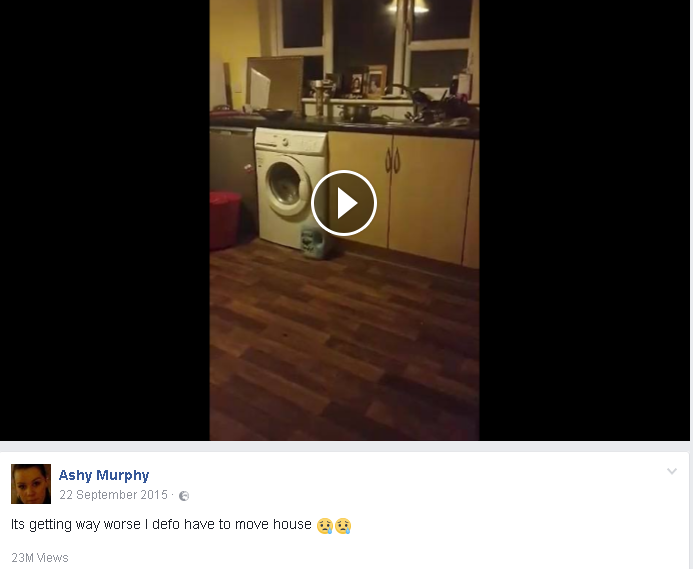
So far, so fake right? So what makes this one stand out from the average piece of ghost "news" offered by the Star or any other tabloid?  Perhaps the fact that the video the Star links and describes in the article was not filmed recently, nor was it filmed in Chile. It was actually filmed in Cork, Ireland and was uploaded to facebook by user Ashy Murphy in September 2015. As of yesterday, the original video had received over 23 million views.

Let's play spot the difference!

Facebook, Sept 2015.


The Star, 28th Feb 2017.


Here's that original version:


The beauty of the original "Ashy Murphy" version of the video is that not only is the original sound is present, but the video is clearer and far less pixelised. This makes it child's play to spot the wires that Ashy has used to achieve her "poltergeist" effect. The final shot of the video being particularly striking.

Now let's play spot the fishing wire!


Wire or thread is also visible on the cupboard door that opens, but it's far less striking and glimpse and you'll miss it.


You can watch Oskar Jungell replicate the effects of Ashy's video below:


There is an actual video (below) that represents the story the Star is reporting on, and the story itself isn't a complete fabrication. It's clear why the Star didn't use the correct video from watching it, as you can below. It's remarkable only for how unremarkable it is.


Essentially all we see is a pillow fly across a room, not convincing in any way. I believe that the Star reporter intentionally attached a more interesting, more eventful video to this article in an attempt to "spice it up" for the simple reason that would illicit more shares, more clicks and more revenue.

It's not every day that you can highlight the Star as lacking even their usual bar lowering standard of journalistic ethics.

I recently appeared on the Spooktator podcast to discuss this story and others with Hayley Stevens and the crew. It was a great discussion if you'd like to watch that discussion it's here:


Monday, 27 February 2017

Brian Cox on Ghosts: Reuploaded.

This is a republished version of my previous post: "Brian Cox on ghosts: the truth hurts" which somehow has become delisted.Celebrity physicist Brian Cox recently made some interesting comments on an episode of the Infinite Monkey Show from Manchester, regarding advances in physics and what they quite possibly mean for some more archaic notions regarding the reality of nature. Referring to the work done at the large hadron collider in Geneva and specifically the discovery of the Higgs Boson and how it relates to ghosts, Cox remarked:
"Before we ask the first question, I want to make a statement: We are not here to debate the existence of ghosts because they don't exist. If we want some sort of pattern that carries information about our living cells to persist then we must specify precisely what medium carries that pattern and how it interacts with the matter particles out of which our bodies are made. We must, in other words, invent an extension to the Standard Model of Particle Physics that has escaped detection at the Large Hadron Collider. That's almost inconceivable at the energy scales typical of the particle interactions in our bodies. I would say if there's some kind of substance that's driving our bodies, making my arms move and legs move, then it must interact with the particles out of which our bodies are made. And seeing as we've made high precision measurements of the ways that particles interact, then my assertion is there can be no such thing as an energy source that's driving our bodies."
 To some Cox' approach here may seem harsh, cold even. He seems to have taken very little care in considering the beliefs of others in the statement and it's comparable to statements he made regarding ghosts in the past. Unfortunately, we have to accept that it's Cox's prerogative to approach the subject of ghosts in this manner. As a physicist, Cox works in a domain concerned with formulating an accurate and utilitarian description of nature. Though unexplored areas of physics sometimes involve more esoteric ideas such as hidden dimensions and many worlds, these aren't wild flights of fantasy, they're mathematically sound and provide an explanation for some aspect of reality that has been shown to exist. Cox has spoken without ambiguity on the subject of ghosts, and I think it's necessary for people to do this. I myself offered an explanation of why the laws of physics don't allow for the existence of ghosts last year. I regretted my ambiguity somewhat when I saw people commenting on the post that I stated in my conclusion that ghosts may exist, but ghost hunters and paranormal investigators must try harder to find empirical evidence. I can see how the conclusion given below could give that impression, but it isn't really how I felt:
"To accept the existence of ghosts requires the rewriting of all of the above laws and theories of physics, does that mean that we should stop looking? Not necessarily, but believers must accept that a high standard of evidence is required to start rewriting the textbooks."
The only aspect of the statement made by Cox in which I really disagree to any extent is that the LHC has proventhat ghosts don't exist. It's just made an existence which already bordered on almost utterly unlikely, even more unlikely. That's why I don't really view this comment as offering anything new to the argument. If you weren't already convinced by Newton's laws, the laws of thermodynamics, Einstein's energy-matter equivalence and literally almost all of physics and biology you aren't likely to be convinced by the LHC's probing of ultra-high energy states.

Belief in ghosts isn't generally informed by knowledge, it's informed in acceptance of anecdote as evidence. In a desire to believe. In the effectiveness of psychological phenomena such as cognitive dissonance in protecting weak and ill-formed ideas. Cox's words, like the words of any other scientist, are unlikely to sway believers in ghosts or any other supernatural phenomena. In fact, it's likely to cause them to do what most of us do when our beliefs are threatened, run to our echo-chambers and lash out at perceived aggressors.

Unsurprisingly, this is what is occurring on facebook and other social media right now.


Aside from the insults, accusations of being a member of the Satanic Illuminati, claims that he is an "astormior" (he isn't) who aren't scientists anyway (they are) and threats to curse/haunt Cox, on the various paranormal groups where I've seen this discussed, I've only seen one real attempt to raise a coherent argument against Cox. The idea that lots of people claim to have seen a ghost, therefore ghosts must exist.

Such arguments don't consider that there isn't some critical mass of anecdotal evidence, at which point it becomes empirical evidence. Nor do they consider cultural influences, psychological factors or the fact that some people just lie. All of which, alongside plain old misattribution, can account for such a wealth of sightings. Looking at exchanges such as the ones above I have to wonder who these people are trying to convince? Their "arguments" certainly won't win over skeptics or anyone who believes that concepts should be supported by some level of evidence. Are these simply exercises in self-persuasion? Isn't that the point of some of these groups? To be echo chambers in which flawed ideas won't be challenged?


This idea speaks a lot about the culture we currently live in, Cox has spoken the truth in so much that it is a pretty close reflection of reality, the laws of physics don't allow for ghosts to exist. And the laws and models of physics become more well evidenced and complete every day. Yet speaking this truth has earned Cox ire and accusations of self-appointed superiority. I'm inclined to paraphrase a very pertinent quote offered by Michael Gove last year:

"The general public are tired of experts." After all. They tend to tell us things we don't want to hear.


Sunday, 19 February 2017

Confronting Quantum Woo. The Double Slit Experiment.

Let's continue with our dissection of the alleged quantum/conscious connection by moving further into the Collective Evolution article, an exploration that will lead us straight to Young's double-slit experiment, without question one of the most famous and crucial experiments in the history of physics. In addition to showing that the double slit experiment doesn't suggest that consciousness collapses the wave function of a particle, I'll attempt to go further and show that the double slit experiment suggests considerable evidence that "consciousness hypothesis" offered by quantum-woo proponents must be false. To do this I'll first suggest a hypothesis for consciousness inspired wave-collapse as I couldn't actually find one in Lanza's book. The article linked above, QUANTUM THEORY SHEDS LIGHT ON WHAT HAPPENS WHEN WE DIE: THE AFTERLIFE gives its evidence for Robert Lanza's "theory" that consciousness relates somehow to quantum physics.
"His theory implies that our consciousness does not die with us, but rather moves on, and this suggests that consciousness is not a product of the brain. It is something else entirely, and modern science is only beginning to understand what that might be. This theory is best illustrated by the quantum double slit experiment. It’s is a great example that documents how factors associated with consciousness and our physical material world are connected in some way; that the observer creates the reality."
To consider this relationship an element of science we first need a working hypothesis. The suggestion of a hypothesis offered by Lanza and others in regard to consciousness caused wavefunction collapse can be phrased very informally as:
"Consciousness can exist separately from matter. This consciousness can be shown to have a physical effect in the collapse of the deBroglie wavefunction of a travelling particle. Consciousness is otherwise physically imperceptible. This effect this best shown in Young's double slit experiment." 
This is my interpretation, as I mentioned above Lanza fails to offer an explicit hypothesis in his book and I've struggled to find one elsewhere. Let's call this the QC hypothesis, and return to it in a moment.

I'm sure many of you are familiar with Young's double slit experiment, but I'll give a brief introduction for those that aren't.The double slit experiment was revolutionary as it was our first outright hint that there is more to matter and energy than first suspected, namely that both light and matter on scales far smaller than that of our macroscopic world display both wave and particle characteristics (Actually, a more accurate description would be that both matter and light can be modelled as a wave and a particle. In reality, light is neither). The concept of particle and wave duality was staggering enough for light, but a series of experiments involving electron diffraction showed that matter possessed the same duality of nature. If you want more details about the double slit experiment, the Wikipedia page is actually a pretty decent resource. Rather than wax on about the finer points, I'll use a computer simulation to show the results of the double slit experiment and what this tells us about the nature of matter. Consider below, when reading the phrase collapse of the wavefunction, this refers to an electron switching from a wave-like behaviour to a particle-like behaviour. For example, the appearance of a single dot on a fluorescent screen is particle-like.


We start with a hypothetical apparatus set up as shown below.

Figure 1:
An electron gun fires electrons through two narrow slits onto a fluorescent screen. Where an electron hits the screen a white dot is left behind. We aren't going to concern ourselves too much with the widths of the slits(1nm) or the energy of the electrons(38V).


Figure 2
As the electrons stream through the slits one by one they appear on the screen seemingly randomly. In fact, this underlines how the probabilistic nature of quantum physics can still be reconciled with the deterministic nature of classical physics. We cannot predict with any certainty where the next particle will strike the screen, but we can predict with absolute certainty the overall distribution of a large number of electron hits.

Figure 3
The final distribution shows wide bands of electron hits punctuated with thin black bars showing virtually no elections strikes. These bars don't line up with the blockages in the equipment, and the distribution clearly doesn't resemble what we would get from firing hard projectiles such as bullets through scaled up slits where we would expect a graph of the hits to be two "humps" corresponding to the openings, with some lying between. Compare that to the graph yielded by our electron firing simulation in Figure 4 below.


This fringe pattern is destroyed if we run the experiment again, but this time with one of the slits, slit 1 in the case below, closed. Figure 5 below.


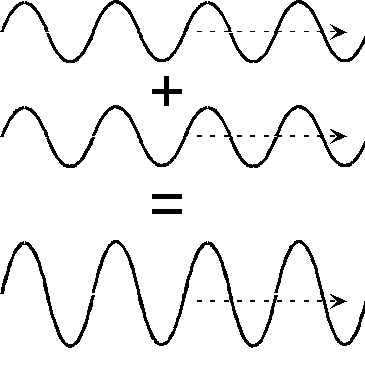
The fringe pattern is known as interference and it can be explained easily using an analogy to water waves. When two waves meet at the point of their maxim amplitude the overall amplitude is increased as in Figure 6 (http://www.phys.uconn.edu) left. The waves are in phase.


When two waves meet with maximum amplitude and minimum amplitude, the waves cancel. Unsurprisingly, this is destructive interference. Figure 7 (http://www.phys.uconn.edu) left. The waves are said to be out of phase.


These patterns are achieved every time this experiment is conducted. Even though the precise build is random and probabilistic, the final distribution is deterministic and fully predictable. Remember this, it's crucial for later when we reassess the consciousness/wavefunction collapse hypothesis. 

These wavefunctions, known as deBroglie waves, are a mathematical interpretation of how a particle propagates through space, they are composed of all the possible positions of the particle at any time and the probability of finding a particle at that particular point. In what follows you'll see why it's necessary to describe the propagation of a particle through space as a wave function. In an attempt to understand these effects in the above experiment, we reopen both slits and turn down the current of the electron gun to allow one electron at a time to hit the screen. Remarkably the fringe pattern returns, albeit slowly, defying the idea that it is the wave function of one electron is interfering with its neighbour. In fact, it's clear that the electron interferes with itself.

Stop laughing at the back!

The consequence of this is we are forced to abandon the classic idea of a particle possessing a single defined trajectory through space. The passage above demonstrates that the particle can be considered passing through each slit, with the contribution of each slit in the wave pattern causing constructive and destructive interference. How does physics explain this? Well.... we can't. We can offer interpretations of this phenomena, such as the Copenhagen interpretation which states that quantum systems don't possess definite properties prior to measurement, only probabilities that reduce to certainties on measurement. There are other interpretations such as many worlds interpretation, but it's the Copenhagen interpretation I'm most comfortable with. There is good experimental evidence to support the idea that quantum qualities become definitive only upon measurement. Einstein argued against this and suggested quantum systems contain hidden variables in his EPR arguments, which were countered by Bell's inequalities and later answered by a modification of the same known as the CHSH inequality. As I don't want to digress too much I won't discuss those further here, but it's well worth a Google search if just to see how even opposition to an idea in science can sometimes strengthen and refine that idea.

So, we're left with an ambiguity, a hole in our carefully crafted quantum science. You may imagine this is where quantum woo merchants begin their machinations, as that's often the tactic of the pseudoscientist, to insert pseudoscience into a gap in conventional understanding. But, It's actually in our attempts to resolve this ambiguity and obtain what we refer to as which way information, that our quantum woo merchants operate.


Figure 8:
In an attempt to resolve the mystery of which slit the electron passes through, we introduce a new element to our experimental setup. We scatter photons off the electrons to see if the electron is in the vicinity of slit 1 or slit 2 and follow their path to the fluorescent screen.

Figure9&10: When we observe the results from this test on our fluorescent screen the interference pattern is gone, replaced by a distribution that is just the sum total of particles passing through the slit. The wavefunction now collapses prior to reaching the screen. It is as if our act of observation itself caused the wavefunction to collapse, and this is most certainly the quantum-woo merchant's interpretation of
this experiment. This brings us to our first misunderstanding supporters have of quantum physics and I can't express how fundamental this is to every conclusion they reach following this.

The Fundamental Error 1: It is not the presence of the conscious observer that collapses the wavefunction, it's the action they perform on the system that causes the wavefunction collapse. 


Let's consider this first in the case of the example given above, electrons fired at a fluorescent screen. When we bombard the electrons with photons the interaction changes the state of the system catastrophically as despite lacking mass, photons do carry momentum.

Mathematically we can show this quite easily if the wave is made of a superposition sum of all the possible states of the particle with constants that represent the probabilities of finding the particle in any of an infinite amount of positions, the probabilities of these possible locations must be 1 as the particle is certain to be somewhere. Therefore if we make the probability of one of these possible states 1 by locating the particle, the other probabilities must be zero! Thus, the wavefunction "collapses" from a superposition to a simple value. I've show this below crudely in a form that describes a "which slit" superposition.


An easy way to understand this physically is by analogy. Imagine me asking you to determine the location of tennis balls I'm firing into a darkened room. The only instrument I'm going to give you to do this is a tennis racquet. There's no way of you doing this without fundamentally changing the state of the ball. You may be able to give me the position of the ball at impact, but you would find it impossible to give me information about the ball after impact. The act of measurement has destroyed the information you had, there is no way you can violently examine that system without changing it fundamentally.

We call any measurable quantity in quantum physics, an observable. Obviously, this is a name that doesn't help the layman distinguish between an "observation" and a measurement". The choice of name seems to suggest that observation is a crucial part of quantum physics, rather than the true meaning of the name: a quantity which can be observed. Other examples of observables are energy, momentum and spin, the above principle applies to these qualities too, any attempt to know one destroys the wavefunction. We often find proponants of quantum woo run versions of the above experiment in which the electrons are fed through spin selectors, therefore collapsing the wavefunction for in the same way as a bombardment of photons does for which way information. We can define this by considering quantum systems to be in extremely delicate balance, with slight perturbations causing collapse.

This is what we find anytime a quantum system interacts with a classically defined object. It's nothing to do with an observer as the following thought experiment should show.

Thought Experiment 1


Of course, the big question is can measurements occur without an observer? The key to considering this idea is to remember that the CHSH inequality has shown there are no hidden variables. Before a measurement is made a quantum system has no determinable observables. In light of this consider this thought experiment.
An isolated nucleus of Uranium 238 exists in the far reaches of space, it has zero momentum. It emits an alpha particle via the process of alpha decay and becomes a thorium 234 nucleus. The conservation of momentum tells us that the total momentum of these two daughter particles must be zero, therefore the momentum in an undefined direction of the alpha particle must be matched by an equal momentum in the negative direction of the thorium 234 nucleus.  Neither direction can be known, until the thorium 234 particle interacts with a particle of dust with a defined location. Suddenly both daughter particles have a definitive directions and thus momentum vectors, they must as there is a physical effect on the space dust.
This interaction can be considered a crude form of measurement, the wave function for both particles has collapsed, no observer necessary.

Finally, let's return to our QC hypothesis, to see how what we've covered strongly implies it is inconsistent with reality.

"Consciousness can exist separately from matter. This consciousness can be shown to have a physical effect in the collapse of the deBroglie wavefunction of a travelling particle. Consciousness is otherwise physically imperceptible. This effect this best shown in Young's double slit experiment." 

Let's  question for a second what we would expect to find if the double-slit experiment was repeated in a world in which the QC hypothesis is true. Surely, an unavoidable consequence of the fact that we can't detect or protect our experiment from incursions and interactions from disembodied consciousness is that we should expect that there would be occasions in which the wavefunction collapses for no discernable reason. It would be as if we'd attempted to gather which way information with the later addition of a photon source and a conscious observer, despite us doing no such thing. If the QC hypothesis were true we would expect to see random wavefunction collapses. This has never been shown to happen. I think that strongly implies that the above hypothesis is incorrect in some way. Either consciousness does not exist separate from matter, or consciousness is not responsible for wavefunction collapse.

 Or Both.

Finally, just for fun.

Thought experiment 2

Plinkett and Nadine are conducting the double slit experiments with the electron gun set to a slow voltage with the particles released at 2 minutes intervals. They do not attempt to collect which way information. As Plinkett observes particle 2 hit the screen at 2:00, Nadine attempts to escape. Plinkett corners her in the living room 3 minutes later. Too exhausted by the struggle to return to his basement lab, he decides to watch the experiment progress on the VHS relay his friends at Lightning Fast VCR set up for him and that he began recording at time 0:00 when the first particle hit the screen. Plinkett tells Nadine when they turn on the VCR they will see particle 3's impression on the screen. Nadine agrees but adds that if they rewind the tape they will see the point appear at 4:00. Plinkett argues that they will not as their was no conscious observer present at this time. He believes the particle will not be present on the tape before 5:00 despite being automatically fired at 4:00. His finger hovers over rewind. 
Who is correct? 
Correct answers get a pizza roll. 

Computer package used: Open University S207, The Physical World: Electron Diffraction.