Showing posts with label poor journalism. Show all posts

Wednesday, 15 August 2018

Ghost hunter claims every house in the UK 'could be' haunted: Lots of ghosts. Not much evidence.

As a long-time follower of paranormal investigators and their interactions with sceptics, there are some phrases and expressions that stick in my mind and can be wheeled out to describe a variety of stories and events. For example, when reading the claims of a ghost hunter printed in a British paper, I think back to Joe Nickell's description of Ed Warren on a classic episode of the Sally Jesse Raphael Show in the 1990's.
"Warren never entered a house that he didn't think was haunted"

ghost hunter and tabloid claim every house in the uk is haunted


Those words echoed through my head as I read a story published in the UK's Daily Star newspaper on the 10th August entitled 'It’s possible EVERY British household is haunted’ Terrifying warning by expert' (1). If you've any doubt what the motivation behind the report is then the strapline 'A GHOST hunter has claimed every British household could be haunted by evil spirits.' should give you some indication.

The ghost hunter (or 'GHOST hunter' according to the Star) in question, Barri Ghai, has been the focus of a vast amount of articles in the Star over the past week. Almost every day he has appeared discussing some very 'clickbaity' aspect of the paranormal.

This has included discussing Elvis' ghost on 6th August and the 'irrefutable proof' that a ghost touched former glamour model, Katie Price's arm on 4th August. All of this attention from the Star is linked to Ghai's upcoming ghost-hunting show set to air on UK digital channel Really, the same channel that airs ailing ghost investigation farce 'Most Haunted.' 

The article in itself is stunningly lightweight, Ghai offers no real insight, a theme that runs through all of his articles for the Star. His main point seems to be that Britain's homes should be particularly vulnerable to hauntings because of their 'history'. "It's not just the home," Ghai says "it's the land around us." A particularly nonsensical claim considering that all areas have a history, what Ghai seems to mean is a history that he is aware of. Does he think that land in other countries didn't have people and animals dying on them throughout history?

He has a strangely 'Anglo-centric' view of history if he hasn't considered this.

It's pretty obvious that the series of articles featuring Ghai is paid promotion to support to the show 'Help! My House is Haunted." making them cheap and cynical. Neither the production company behind the show, Really or the Star care if these articles are lightweight junk. Not even if it's lightweight junk that misleads or causes fear and anxiety.

I view the article in conjunction with the recent story that went viral by ghost hunter Gary Parsons, claiming that the heatwaves experienced in the UK are responsible for a rise in ghost sightings (2). Neither article has the slightest bit of evidence behind them and both seem to offer an excuse for the tabloid press to print further ghostly nonsense.

But there is a worrying trend here. In an attempt by these ghost hunters to make themselves relevant they are exposing potential sensitive and scared audience to the idea that ghosts exist, but they are everywhere.

There isn't a lick of evidence to support these claims, of course. We're being told that Ghai, Parsons and others cited in the articles are 'experts' but were are the telltale signs of expertise? Here's a striking example that the addition of an implied expertise done simply to lend credence to nonsense. It's an argument from authority.
"Technical paranormal expert, Robert Bryant, said: "With temperatures soaring its having an unexplained increase in paranormal activities."
Ok. So he's a 'technical expert'. Surely that means we can expect him to talk about some technology, maybe attempt to offer an explanation as to why high temperatures may be leading to an increase in ghost sightings from a physical standpoint?

Well no. After briefly mentioning the 'Huff WonderBox' (yes, this 'technical expert' couldn't identify a broken radio when he purchased it for hundreds of dollars), Bryant offers this gem:
"On a recent house investigation, my body was taken over by a dead priest and refused to leave until it was ordered to leave by my colleague Amanda Oriana."
Yeah. Dead priests can be stubborn, sounds like you got lucky if this one left your body after just being told to do so.


Not very technical though is it?

I'll be honest when I saw the headlines of this series of articles I was excited. I haven't talked about the supernatural or debunked any paranormal claims for some time. I wanted to, for the summer at least, dip my toes back in. Maybe do a few old 'Skeptic's Boot' style articles. But what I instead found was a commentary on a major reason I haven't been touching this stuff of late.

There's really nothing here to debunk.

I really feel like we've come full-circle with the claims of ghost hunters and the attitude the tabloid press has towards them. There's no need for 'evidence'to build the claims around anymore. Journalists are simply looking for a paranormal-themed story to write that centres around a possible 'news hook'.

People are reading articles about the heatwave the UK experienced in June and July, so journos go out and find an 'expert' willing to sell them bullshit centred around that. Readers are always interested in celebrity stories, let's centre a ghost story around that.

Nickell's comment about Ed warren that I featured at the head of this post has come to horrific fruition. There is now a huge swathe of ghost hunters who are unable to walk into a home that they don't think is haunted. In Ghai's case, he's quite happy to tell you that your house is haunted without ever stepping foot in the same street! And there are tabloid media more than willing to serve that up to their customers.

The problem that this presents to sceptics is this, there's that old adage "What can be claimed without evidence, can be dismissed without evidence" but this is a double-edged sword. Sure, on one hand, it means we can increasingly dismiss the claims of ghost hunters without a second thought. But it also means that we are deprived of the opportunity to change the minds of believers and fence-sitters.

That's concerning. Especially as many sceptics and debunkers of paranormal claims were once believers. They had their mind swayed, in many cases, by coming across the work of a previous generation of sceptics, by convincing well-laid out auguments.

How do we build an argument on nothing substantive? Other than pointing out how unsubstantive it is?

References


(1) https://www.dailystar.co.uk/news/weird-news/722509/Ghost-news-every-British-household-haunted-warning-video

(2) https://www.dailystar.co.uk/news/weird-news/721496/UK-heatwave-weather-forecast-ghost-news-paranormal-investigators

Saturday, 10 February 2018

The 'JAMES H RANDI' Framework: Assessing Science Reporting.

It's vital to acknowledge that most people do not get information about the sciences from peer-reviewed papers, instead relying on the media to disseminate information to them. There's nothing intrinsically wrong with this, but most journalists are not qualified in the sciences, this includes actual science correspondents and content writers for science periodicals like New Scientist and Scientific American. Headlines are often vastly exaggerated or outright false. The articles in question may not reflect the findings of the paper or study they concern because the journalist failed to understand what they were reading, they took the information in their article from a secondary source that was incorrect or they've blatantly misrepresented the findings of the research to fit some other narrative or belief. Of course, there's another possible reason for the article being wrong, it may accurately represent the study it reports, but that study may itself be deeply flawed. So it's vital to review how to assess a news article that relates scientific findings.

https://wattsupwiththat.com/2017/12/30/editorial-narratives-in-science-journalism/n


In what follows I'm going to draw heavily on the work of Kevin McConway and David Spiegelhalter (1), two statisticians, who after getting tired of hearing bogus medical claims on the morning radio, developed a framework to assess the reporting of medical studies in the press. At points, I'm going to generalise to make the points apply beyond the medical sciences. My adapted framework contains eleven questions divided into two categories, study quality and the standard of reporting.

Scoring your article

All the questions in the framework can all be answered 'yes' or 'no' but you'll notice that they are sometimes worded in a quite ungainly fashion. This is because one point is awarded for a 'yes' and zero points are being awarded for a 'no'. Thus the higher an article's score the less trustworthy it is. An article with a score of seven or above should be considered deeply flawed, an article with 10 or more, utter bunkum.


Quality of study.


1. Just Observational? 


Have the researchers made any attempt to control for other variables or have they simply observed a process without interference? Whilst a lack of experimenter tampering may sound like a good thing, failing to apply proper controls make it extremely difficult to link a cause to an effect. Imagine testing a medical intervention but failing to control for other treatments. How can we tell which medical intervention caused an observed improvement?

2. Another Single study? 


What journalists often fail to realise is that scientific consensus cannot be built upon the outcome of one study. We should establish if the study in question has been successfully replicated, or if the results found reflect those found in other, similar investigations into the same phenomena. 

3. Might there be another explanation for the observed effect?


Is there a confounder that might explain the found results? The experimental controls should allow the researchers to eliminate plausible alternative explanations for an observed effect. Imagine experimenters are testing a new cold remedy. They select two groups, men and women. They give the women the new drug, but not the men. They find that the women in the group administered the medicine tend to recover more quickly than the men and report less extreme symptoms. They conclude the remedy is successful, but they have failed to control for gender. The experiment is confounded.

We should also consider any systematic bias, have the researchers introduced an element into the study that will skew the results in favour of one particular outcome? A striking example of this would be a recent survey issued by the Trump administration comparing voters opinions of the first year of Trump's first term to the first term of Obama's first term (below). You'll immediately notice that the first question has an element missing. Subjects are unable to rate Trump poorly whereas the option is available in the second question which asks subjects to rate Obama's first term(2). This quite laughable omission means that a side by side analysis is unsuitable.


4. Extrapolating Small sample sizes?

We should be extremely wary of studies with small sample sizes, especially those with subjects numbering in the tens rather than the hundreds or even thousands. There are mathematical ways to calculate appropriate sample sizes, but often it's easy enough to do this intuitively. You can't draw conclusions about millions of people based on a study of tens.  For example, consider Andrew Wakefield's withdrawn Lancet study which attempted to establish a link between the MMR vaccine and autism. Wakefield's study group contained five children, clearly not enough to draw conclusions about millions who had received the MMR vaccine. We need to be even more concerned when the conclusions of a series of tests are extrapolated to a much larger population

In relation to sample sizes, it's important to be wary of larger of studies of rare events. For example, a study of a rare illness may involve following millions of people but only an extremely small number of that sample develop the illness in question.

5. Samples not varied enough? 

Related to the previous point, it's not suitable to draw conclusions about a large population based on a sample that isn't varied enough. A good example of this is the study I looked at with the Spooktator crew early last year. The study proposed to show that individuals with strong religious or supernatural beliefs have poor cognitive abilities. The problem was, not only were the sample sizes extremely small but the vast majority of those studied were aged under 25 and female. It's not possible to draw conclusions about millions of believers of all ages and both sexes from such small, unvaried sample sizes. 

Standard of reporting.

6. Half (or less) of the story?

Are the reporters telling you everything? If they are reporting on the harmful effects of a medicine are they pointing out the benefits as well, or vice versa? Are they highlighting a small part of the research and ignoring the bigger picture? Researchers will normally point out flaws with their studies and suggest avenues for further research. Are these elements being covered in the report?

7. Representing risk in a misleading way? 

Watch out for the phrase "higher risk" in a report. If you are told that exposure to a substance doubles your risk of a certain ailment or illness it sounds quite bad. But what if your risk was incredibly low, to begin with? Unfortunately "X doubles the risk of Y" makes a fantastic attention-grabbing headline. This can also be true when considering a stated effect. If some variable makes the chance of a positive outcome more likely, we need to know how likely that outcome was in the first place to know if that is significant or not. To combat this we should be looking at absolute numbers as a sign of good science reporting.

8. An Exaggerated headline? 

Headlines for articles can be difficult to construct, this sometimes means important details are omitted, worse still they can be abandoned in favour of hyperbole. Does the headline of the article actually reflect what is said in the actual report, or is it misrepresentative or manipulated?

A great example of this would be a study published by the International Agency for Research on Cancer (IARC) reflecting the decision to list the radiation from mobile phones as “possibly carcinogenic to humans” or in specific terms to place classify it as a group 2B carcinogen (3). The 2B category is used when there is no specific evidence of a substance or material posing an actual risk, but there have been correlations made in the past. Some other 2B carcinogens include; fuels, laundry detergents and aloe vera.

The Daily Express clearly weren't interested in these details when they reported the IARC's report with the headline: "Shock Warning: Mobile phones can give you cancer" (4).

This headline complete strips the subtlety of the IARC report in favour of hyperbole and blind panic.

9. No Independent Comment?

When considering a scientific study it's vital to remember our first point, single studies do not make the scientific consensus. That means that we should be looking for independent comment from someone in the field of research not involved with the research in question to put our study in context. If an article omits this, it's likely based on promotional material issued by the institution that produced the research, one that has vested interest and may well not be as even-handed as one could hope. This doesn't mean these comments have to be negative, but they should be present.

This leads us to...

10. Does the report rely on public relations puff pieces, or are there considerable personal interests involved?

Are there elements of the report that imply the study is just PR? Who sponsored the research? What was the ultimate aim of the study? Does it fit into a wider scientific context? The answers to these questions are likely to tell you whether you should take the report with a pinch of salt or a shovel. This isn't to say that research that has been paid for by a company or corporation should be immediately disregarded, but it should be viewed with some skepticism. Likewise, research conducted by individuals with considerable personal interests in the research should be considered with suspicion.

For example, Martin Pall's research (5) on the dangers of electromagnetism should be weighted alongside the fact that he sells a range of supplements that he claims to strengthen the biological systems which his research claims EMF 'attacks'(6). Is this conflict of interest mentioned in the report, or in the original paper even?


.

11. Is the original research unavailable?


A great deal of the time, you'll find that the article you're reading doesn't even link to the original study. This means you're going to have to do the legwork yourself. The original study should be searchable by title if this gets you no results try searching by selected keywords. When doing your search, you may be far more likely to find success searching using an academic search programme such as Google Scholar (7). When you find your paper, it may well be hidden behind a paywall. Don't despair, even if this is the case, the abstract will be available for free. You will more likely than not find that this alone is sufficient to find errors in sloppy articles, especially if the author didn't even bother to read the abstract as often is the case!

Conclusion 

If you're slightly worried that all that may be difficult to remember, fear not, I've formed it into a handy mnemonic, JAMES H RANDI after my skeptical hero. You could always rework the framework to spell out the name of your own hero of science or skepticism. I've also formed the questions into a rudimentary scorecard which you can see below and download by following the link in the sources (8). Hopefully, it should make assessing science articles much easier.


Sources

Thursday, 25 January 2018

A Hole In His Story.The Unexplainable 'Ghostly Monk' of Eynsford Castle Explained.

Ok, it’s never easy to do this, but I have to admit that I’m wrong about the recent Castle ghost. After a lengthy talk with Kenny Biddle, he finally managed to explain where I’d gone wrong.

So apologies to everyone who has shared and liked the post that follows. All I can say about my mistake is that the nature of science is that you correct your position when you’re faced with new evidence.

Also, got to mention that Bear fella and a commenter called Chris on the blog, who also pointed out my error.

As for what the image actually is, I suspect Kenny will pick up the cudgel on that, so I’ll leave the reveal to him.

Apologies again.

- Rob.

The Daily Record reports today on a spooky apparition appearing on an image taken at Eynsford Castle, Kent. The image, taken by Jon Wickes alleges to show the spectral figure of a hooded monk(1). The Record tells us that Jon enlisted the help of paranormal investigator Alan Tigwell, who assured him there is 'no explanation' for the image. The story is almost certain to hit the Star and the Mirror in the next 24-48 hours. Let's take a look at it and see if we can find an explanation first.


Here's Jon's Image.


 And a closer look.


The investigator, Tigwell tells the Record he visited the castle twice to search the area for potential answers before declaring it 'unexplainable'.
"I went to the site twice last Thursday – in the morning when it first opened and later on. The purpose of my visit was to ascertain whether there was anything within those walls to explain the picture. I've been investigating the paranormal for over 20 years. The difficulty with looking at things retrospectively is that it's impossible to say exactly what something is.All I can say is that there wasn't anything in the castle itself that could explain that picture."
Hmmm... "within those walls..." these words may come back to haunt Tigwell.


I can't get to Kent at short notice, so I decided to use the wonders of Google to attempt to solve this mystery. I used street view to get as close the castle grounds as possible. The first few images gave me a pretty clear idea of what our 'phantom' actually is. 


The various walls of the Norman castle are punctuated with doorways and openings. Some of which may appear dark in poor lighting conditions due to the fact that they have walls immediately behind them. After forming this idea it was a case of finding the area in question and checking it for such openings. Luckily the area photographed was quite distinctive having the bridge, steps, wall and river in the same shot and there is a wealth of shots of the Castle on the internet.

Sure enough, I managed to find the exact area. The only remaining issue was that as the image was taken in an open field, there was a multitude of angles that other photographers could take pictures of the wall in question from. After a tiny bit of searching, I found an image that fit the bill, taken in July 2017.


A side by side comparison shows it is the same area taken from a slightly different angle. And if we zoom in somewhat, we can distinctly see the top of the opening which the Record is claiming is a ghostly monk.


The last thing to do is check this is actually a feature on the wall. To do this we can use the fact that the image was taken at a slightly different angle but at roughly the same distance from the wall to bust this ghost. All we have to do is choose a reference point on the wall we think the opening is based on. We then measure how much this reference point (1) shifts from our test image (A) to the image featured in the Record (B). If the 'ghost' is simply a feature of the wall we should expect it to also shift by a comparable amount. You may want to click on this image to enlarge it.


Indeed we find our reference point (1) moved by roughly -40mm and our 'ghost' shifted by roughly -37mm. I put that 3mm drift down to the relativity low level of accuracy we've used to measure the shift and the slight difference in distance between the point where A and B were taken.

I think this one is well and truly debunked. On to the Mirror and Star to republish it regardless, like the peerless journals they are. As for Tigwell, I don't want to be rude, but perhaps focus more on the earning second half of the title "Paranormal Investigator" and a little less on justifying the first.

Sources

(1) https://www.dailyrecord.co.uk/news/uk-world-news/dad-photographs-ghost-monk-medieval-11907283

Thursday, 2 March 2017

The Daily Star and The Chilean Poltergeist: Upping The Ante On Fake News.

At a time when everyone is talking about "fake news" and which news sources and stories should be deemed "fake" The Daily Star has taken the bold move to claim the title in perpetuity. Their stunning effort to capitalise on the fake news phenomena comes with this story from 28/02/17, entitled "Chilling video of family home so HAUNTED it was evacuated by police." 

The report tells us of a Chilean family allegedly forced to flee their home after calling the police to investigate an alleged haunting.
"Officers were called to the property after reports of a fire but when they arrived the residents admitted they had actually called because of the strange activities happening inside. They claimed objects had begun floating and moving. Video of the alleged poltergeist has been published online."
The Star links a video at the top of the page and gives a description of the events that take place in the video.
"In the clip a light fitting seems to sway all by itself before a broom in the corner moves. Objects on the kitchen counters including a frying pan then move before a cupboard door flies open. Finally, a bucket flings itself across the floor. While the authenticity of the video cannot be guaranteed, officers who were called to the house in Puerto Montt, Chile, claimed they were attacked by a knife that jumped out of nowhere."
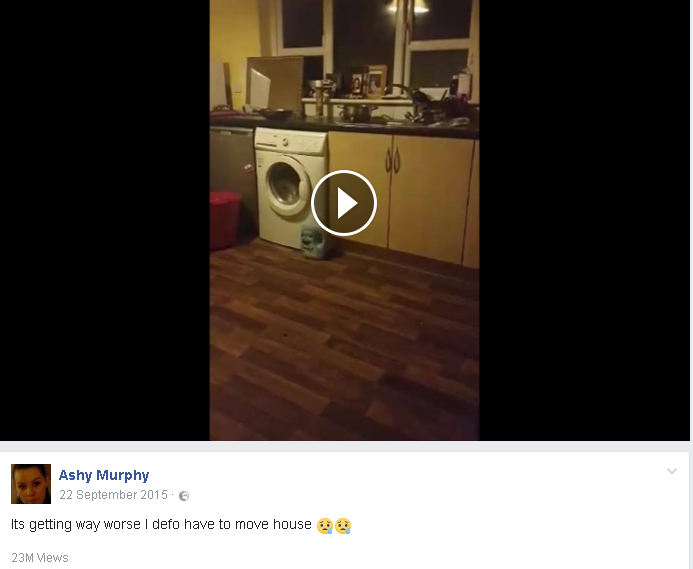
So far, so fake right? So what makes this one stand out from the average piece of ghost "news" offered by the Star or any other tabloid?  Perhaps the fact that the video the Star links and describes in the article was not filmed recently, nor was it filmed in Chile. It was actually filmed in Cork, Ireland and was uploaded to facebook by user Ashy Murphy in September 2015. As of yesterday, the original video had received over 23 million views.

Let's play spot the difference!

Facebook, Sept 2015.


The Star, 28th Feb 2017.


Here's that original version:


The beauty of the original "Ashy Murphy" version of the video is that not only is the original sound is present, but the video is clearer and far less pixelised. This makes it child's play to spot the wires that Ashy has used to achieve her "poltergeist" effect. The final shot of the video being particularly striking.

Now let's play spot the fishing wire!


Wire or thread is also visible on the cupboard door that opens, but it's far less striking and glimpse and you'll miss it.


You can watch Oskar Jungell replicate the effects of Ashy's video below:


There is an actual video (below) that represents the story the Star is reporting on, and the story itself isn't a complete fabrication. It's clear why the Star didn't use the correct video from watching it, as you can below. It's remarkable only for how unremarkable it is.


Essentially all we see is a pillow fly across a room, not convincing in any way. I believe that the Star reporter intentionally attached a more interesting, more eventful video to this article in an attempt to "spice it up" for the simple reason that would illicit more shares, more clicks and more revenue.

It's not every day that you can highlight the Star as lacking even their usual bar lowering standard of journalistic ethics.

I recently appeared on the Spooktator podcast to discuss this story and others with Hayley Stevens and the crew. It was a great discussion if you'd like to watch that discussion it's here:


Friday, 15 July 2016

Week In Weird: Emphasis on "Weak"

The Paranormal "news" site Week In Weird caught my attention a few weeks ago and, as is often the case, spawned a segue into another topic that I'm currently working on. Although that post is in response to a comment made by Week in Weird's Dana Mathews, it isn't about Week In Weird per se. This post is.

On the 12th July, Dana posted a column entitled "Ghost Photo Roundup: Investigating the Internet’s Weirdest Paranormal Pictures" which even a person using the most liberal definition of the word "investigation" would be forced to admit, is nothing of the sort. There is quite literally no investigation here at all, something that I can quite easily demonstrate by highlighting a familiar face. Hello Little Ghost Girl, described here as "Ghost in the hallway." Below is a comparison, the image featured in the Week in Weird article is on the left, another example on the right.


You can forgive Dana for failing to recognise this image, it's only the most famous ghost app image in existence. Here's the story that Dana gives for the image.
"This exceptionally strange photo was snapped by a group of carpenters in Norway who were hired to perform renovations on a historical site. Unfortunately, after just a few weeks, the men began experiencing some unexplainable activity. The strange knocks, disembodied voices, and other mysterious phenomena got so bad that the men refused to finish their work on the basement. After a particularly active day, one of the men took a series of photos down a particularly problematic hallway, and when they discovered what resembled a “white shadow resembling a man” in the images, they left and vowed never to come back."
Of course, Dana gives no source for this story, the only other reference to it I could find was on pinterest. Dana, or her source perhaps, has elaborated on the story offered there somewhat. Googling "Norway Carpenters basement knocks ghost" gives one precise result: the Week in Weird article in question. So not only is this photo not investigated, it seems completely fabricated (Edit: In the comments section Torkel has provided the original source, there is also another photo.)

In discussing the next photo Dana shows a stunning lack of investigation and general knowledge of the paranormal scene.


Here's what Dana writes about the image:
"This odd photo was taken on January 11, 1978, and has been at the center of many debates about the validity of the image. According to the photographer, Richard Wiseman, the woman shown partially hidden was not only not there when the photograph was taken, but at the time Wiseman was sure he’s never seen her at all. Of the many photos taken that day, this was the only picture that the mysterious woman appeared in."
Now had Dana done the slightest bit of digging, she'd have realised that the Richard Wiseman in question is, in fact, arch-skeptic, psychologist and magician Richard Wiseman the author of Paranormality. He didn't take the photograph at all, and it wasn't taken in 1978 but 1987. Wiseman's association with it comes from his website where he describes it as follows after it was sent to him in 2009:
"...this week I received another interesting ghost photo….“This is a photo of myself, my mother, and my newborn daughter taken January 11, 1987. The face beside the lady holding the baby is no one we know. We have several pictures from this day and this is the only one with the face. Can you tell me what it could be? A ghost? I get the feeling that it is not a benevolent, whatever it is.”
The person says that she has the print of the picture and perhaps the negative."
Now it's pretty clear from the photo what is going on here. Several commenters on Wiseman's blog suggest it's a double exposure, but I think that's an actual person sat behind the main figure. The person in the Coca-cola jumper seems to be looking at the person sat behind the main figure. Also, her face is similarly washed out and pale. In addition to this, I'm pretty sure the"ghost's" shadow can be seen on the vase in the background. The only evidence we have that there was none sat behind the lady in the photo is from the person who submitted it. Now I'm not suggesting that the submitter may be lying, though that is a possibility, but it's more than possible that she simply misremembers a party from 22 years ago. I don't see any reason to even begin to suggest "ghost" here. Far more likely a trick of perspective and memory.

Speaking of tricks of perspective:


Here's what Dana says about this one:
"Taken by a woman known only as “Heather in Pennsylvania”, this photobomb would have sent me running in the other direction. Forget the kid, I’m gone.
“I took this photo of my son with my Samsung Verizon camera phone,” Heather wrote. “He was sitting with his back to the couch. I’m still trying to figure out what the apparition is behind him.”
Skeptics have theorized that the image is just a reflection, however, the photographer was on the other side of the phone taking the actual picture and claims that no reflective surfaces were facing the lens.
The earliest use of this image seems to come from a blog published in 2012, and Dana pretty much quotes the story verbatim.

Again all we have here to suggest anything unusual about the photo is the insistence by the person who submitted it that there was no one else present. I'm don't really buy the idea of Dana's reflection. It doesn't appear to me that the child has his back on the back of the couch. He seems much further forward and higher. In my opinion, he's sat on someone's knee, I'm pretty sure that I can actually see the shoulder of the person in question.


Could she be leaning out to one side in an attempt to see her phone screen as she snaps a selfie of her and the child? An alternative explanation may be the child moving his head as the image is taken resulting in a "slow-shutter speed" effect, although I prefer my former explanation.

Here's the final two images featured. I'm pretty sure the first is an extremely poor photoshop. Even Dana acknowledges this. There's much else to say as the image resembles a figure in only the loosest possible sense. It looks more like the symbol that appears on toilet doors that either an actual person or a ghost.


The final image(left) may well be another photoshop, the black shadow surrounding the figure is of a much greater richness than any of the other shadows in the image. Another explanation is possibly a prowling animal. That would certainly explain the glowing red eyes.

What irks me about this post isn't the misattribution of paranormal explanations to the pictures exhibited, or even the pretty wholesale rejection of possible rational explanations. Rather it's the sheer laziness Dana displays. She clearly didn't even bother to Google search the images or Richard Wiseman's name, I get the distinct image she pulled them all from pinterest in an afternoon. Where further information wasn't available Dana has simply invented a backstory. There isn't any real content here, there certainly isn't anything even resembling "investigation." To put the article into context, here's how Week In Weird describe their content:
" With its lighthearted, middle of the road approach to the unexplained and the best-written weird news content on the web, Week in Weird has become a regular source of material for huge media outlets like VICE, Mental Floss, Coast to Coast AM, Gawker, The Fortean Times, and Mysterious Universe to name just a few."
Firstly "best written?" The post I read was barely written at all. When I read the above passage all I can think is "fluff". This is fluff, they know it's fluff. The claim it can be used as a source is laughable. The site is another example of people with an interest in the paranormal, believers and skeptics alike, being sold short again, and its a thumb in the eye to anyone who values the concept of investigation.

We deserve better.

Sunday, 20 December 2015

I Heard It Through The Grapevine: How Tabloid and Sensationalist Filters Can Change A Legitimate Scientific Study into Something Paranormal.


Ever come across a post or a story on social media or elsewhere proclaiming that science or scientists have "proven" some element of the paranormal? Often there is legitimate research behind the claim, but it's been twisted by tabloid journalists and bloggers so much that the end story barely reflects the original source.

Case in point.

I came across this post recently on paranormal Facebook page "The Haunted Informer". Naturally it peaked my interest. For any study to reach such conclusions it must have been incredibly wide-ranging, either that or the headline was complete hyperbole. I wasn't surprised by my findings, but it presents an interesting case study of what happens to a legitimate piece of science journalism when it passed through first tabloid filters, and then the filter of a paranormal hobbyist news site. Hopefully, this should demonstrate why the resulting audience is being deeply misled with regards to how and why studies such as this are being conducted.

To do this, I traced the story back from the report on Horror Movie Blog through the source it cites to, from what I can see its first appearance on the internet. I'll "play it back" chronologically showing what was chopped, added and altered at each stage. Links to the relevant papers and studies in dateline placed under sub-headers.  I will give each stage a score that reflects how close to the primary source the article is.

Primary Source: The Original Study


End-of-Life Dreams and Visions: A Longitudinal Study of Hospice Patients’ Experiences (Kerr, Donnelly, Wight et al, 2014) published in JOURNAL OF PALLIATIVE MEDICINE Volume 17, Number 3, 2014. I'm not going to delve too deeply into the study itself, but there are important details about it which any report should probably at least touch upon.

I'll score a point for each of following criteria, I'll remove a point for any significant additions that aren't alluded to in the primary source.

  • The purpose of the research. What does it set out to investigate?
  • Who is conducting the research?
  • The methodology. 
  • The number of subjects. 
  • The variation in the subjects interviewed. Age, gender, ethnicity, etc.
  • The location in which the study was conducted. The period of time it was conducted over.
  • The results of the study
  • Any significant limitations. 
  • Conclusions reached
  • Citation of correct sources, i.e: primary source. 
Fortunately most of this information is available, as with most scientific studies, in the paper's abstract, reproduced below, so any journalist or blogger worth their salt could easily access this and assess without a aptitude for reading such material and with little to no background knowledge. 


As standard, the paper lists any significant limitations with the study.
"There were some limitations to the current study. Many patients were already experiencing ELDVs at the time of initial enrollment, making it difficult to analyze the time course of this phenomenon. Limited research staff and the dynamic nature of a hospice inpatient unit (e.g., frequent death of potential participants) also made it impossible to approach every eligible patient. A portion of the patients experienced dementia or delirium as well as ELDVs; however, only three dream events were reported by patients with dementia. Future studies should more fully control for delirium, utilize a more comprehensive questionnaire, and interview patients who are less proximate to death to capture the phenomena as they emerge or change. In addition, the interrelation of delirium and ELDVs, especially in the last few weeks of life, should be investigated further," 
They could have highlighted some further limitations. Any findings of this study only applied to terminally ill patients receiving palliative care. The research is carried out in one location so its highly subject to cultural bias of the subjects involved which is likely to shared. Therefore it can't be extrapolated to all people in all situations. The likely reason that this isn't mentioned, is it's a given really.

Bear this in mind.

Scientific Journalism Source: Science Daily
Cited Source: Primary Source

The first thing to note is that both the study and the paper are clear that what is being discussed is dreams or visions there is no indication of anything supernatural. Its isn't even implied. 


Additions to the previous source

Quotes from the authors which obviously aren't in the paper, which aid the reader's understanding the the study and the processes involved. There's a good reason for them to be there, after all this isn't an abridged paper, its journalism. 

Score: 8/10

Journalist's Source: NewsWise. 

Cited Source: Primary Source

Newswise is a press release service and news wire for journalists, therefore this is probably the first port of call for most journalists. Unfortunately its probably as deep as most journalists will probe. This means that significant errors or omissions here will likely be replicated in subsequent reports. The report is exactly the same as the source above. Its not clear to me which article came first, I'd say its pretty clear that both sources either received the same information from each other or the same press release from Canisius College. Obviously, as this is the case, the word count is also the same.

Therefore, the score is unchanged.

Score: 8/10

On this basis, there's no legitimate reason why any of the following articles should score less than 8.

Tabloid Source: The Metro (Rob Waugh)

26 Oct 2015 4:23 pm
Cited Source: Not Given, likely to be above News Wise article


You'll probably be unsurprised to learn that it's at this tabloid stage that the major omissions and additions are introduced. It's no coincidence that up to now there's been no financial imperative to push "hits" or visits to the articles. None of the previous sources had advertisers to pander to. The Metro certainly does.

The first major change: The title of the article. The titles of the science source and the journalistic source were pretty much the same, "What dreams may come: End of life dreams may be comforting" and "What Dreams May Come" respectively. Now the title is slightly whimsical, and the decision by Newswise to drop the second half of the title makes it pure whimsy and less informative, but it's likely this is the title of Canisius college's press release. But that's a small sin when compared to the Metro's chosen title: Almost ALL dying people are ‘visited’ by dead friends in their final days, study finds.

 
Clearly. this isn't what the study says, the experiences of 66 people (or 58 if you consider the subjects who actually complete the research) all receiving strong pain medication within a hospital setting, in the Western world, in one city, one hospital, cannot be extrapolated to THE ENTIRE HUMAN RACE. The researchers themselves attest that this is a small sample size something Rob Waugh, writing the Metro article never mentions, indicating he never bothered to check the findings of the original paper.

Another addition is that of a ghostly picture (opposite) laughably titled "Ghost?", likely, when coupled with the deeply misleading title, to fool those who spot it on their newsfeeds or on the Metro's home page into believing this is in some way a paranormal story, which it clearly isn't.

The Metro's word count is also vastly reduced compared to the previous two articles, standing at just 139 words. To put this into context Waugh has trimmed 60% of the News Wise piece, the result being the omission of several aspects that are vital to the accurate reporting of the research. It's telling that the Metro manage to keep one of the only elements that even slightly suggests a supernatural element to the study. Obviously. this is robbing the following quote of the context that these are heavily medicated terminally patients here:
"Many patients said the visits ‘felt real’ – and that visions involving dead friends and relatives were the most common."
So what does the paper actually say about the occurrence of  "visions" of dead relatives?
"The categories included deceased friends or relatives (46%), living friends or relatives (17%), other people (10%), and deceased pets or animals, living pets or animals, religious figures, past meaningful experiences, and other content not listed (singly and in combinations, 35%). Note that the total percentage is greater than 100% because multiple responses could be recorded for each event (e.g., deceased friend/relative and living friend/ relative in the same dream)." (Kerr, Donnelly, Wight et al, 2014)
This really brings into sharp focus how poor Rob Waugh's reporting is here. Perhaps almost all of patients involved in the study experienced visions and dreams of dead relatives, but these this still accounted for less than half the total number of experiences. Also. the focus of the paper was not to ascertain how common these experiences are, but what effect they have on the patient's comfort level. Clearly Waugh didn't read the paper or completely failed to understand it.

Here's how the Metro stacks up. Not pretty.


Score: 3/10 But wait, let's make our adjustments for the addition of a hyperbole loaded title and the supernatural aspects. 1/10.

Enter the Blogosphere: HMB (Nadia Vella)
OCTOBER 31, 2015 11:02 AM

Cited Source: The Metro (26th October 2015) Oh Boy!

So the first change that should be noticed is the switch of the photo from Ghost? used by the Metro to an image that should be entitled Ghost! The image used reflects Vella's attitude to the story. You'll notice it reflects nothing of the actual paper. There's a ghost not a vague dreamlike image, no hospital setting, not a terminally ill patient but a soundly sleeping child.... at least the image chosen by Waugh demonstrated some ambiguity. But its due to his manipulation of the story that Vella has concluded that this is supernatural in nature. 

As for the other changes... well there aren't any. Vella actually has the nerve to blatantly copy and paste the Metro article and still credit herself in the by-line. Jesus, I know she's only a blogger, but have SOME integrity! She doesn't change so much as one word, she then links to her "source" the Metro! It's not your source you moron, it's your exact article with a different photo!

Score 1/10 minus 1 for changing the photo, minus 1 for being a complete hack -2/10
Sigh. 

You have to pity the research team that conducted this study. By the time their years of hard work reaches the general public its so warped by ignorance and click baiting, sensationalism and bad journalism that its hardly recognisable. Think of those 66 people who took part in this study back in 2011. They spent precious moments, their last indeed, taking part in a study to help us better understand perhaps the most unifying and fundamental aspects of our existence. Did they deserve that sacrifice to be sullied?

The ultimate irony in all this can be summed by the sentence taken from the well-written paper that Vella and Waugh were probably barely aware even existed:

"Despite the value of such experiences, patients, families, and clinicians report their reluctance to openly discuss ELDVs for fear of ridicule and doubts concerning medical legitimacy" ((Kerr, Donnelly, Wight et al, 2014)

This fear is hardly going to be alleviated whilst serious studies such as this are being manipulated into paranormal click bait, the public's perception of these studies won't change if they see them reported in the Metro's "weird news" section, or on a blog that promotes the existence of ouija board demons, ghost sex and shadow people.